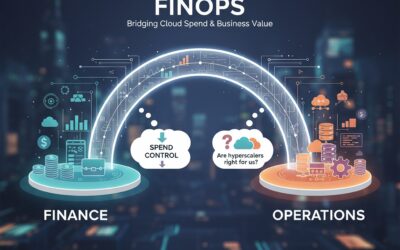
For years, the narrative has been clear: the cloud is the future. Every enterprise wanted to get there fast and most did, often with a single hyperscale provider as their backbone. The FinOps movement brought discipline to this expansion, but a deeper reality is now emerging: reliance on one cloud carries risk, while running on two often doubles your complexity and cost.
Some organisations are quietly asking the unthinkable:
What if it’s time to bring our most stable, persistent workloads back on-prem and keep the cloud for what it’s truly best at: agility and burst?
The Single-Cloud Trap: Convenience with Hidden Risk
Relying entirely on a single hyperscaler, whether AWS, Azure or Google Cloud, has undeniable appeal: unified billing, simpler IAM, consolidated security controls and tighter integration.
But there are strategic and operational risks baked in:
- Pricing Power: When 90%+ of your workloads live with one vendor, you’ve ceded leverage. Annual pricing reviews become one-sided conversations.
- Service Lock-in: Proprietary managed services (e.g., databases, AI accelerators, observability tools) make switching technically painful.
- Regulatory and Data Sovereignty Exposure: Jurisdiction changes or data-residency requirements can suddenly make your architecture non-compliant.
- Platform Outages and Supply Limits: Even hyperscalers have regional failures or capacity shortages. If your entire critical path depends on one, resilience becomes theoretical.
So, many organisations explore multi-cloud as a hedge. But that introduces a different set of problems.
The Multi-Cloud Mirage: Twice the Cloud, Twice the Burden
At first glance, multi-cloud sounds like resilience and freedom. In practice, it often means:
- Duplicated Tooling: Two sets of monitoring, IaC templates, security baselines and compliance attestations.
- Skilled Labour Scarcity: Engineers fluent in both ecosystems are rare and expensive.
- Data Gravity Penalties: Moving data between clouds can destroy TCO models once egress and replication costs are factored in.
- Slower Delivery: Each feature must work consistently across environments, adding friction to agile teams that crave speed.
Instead of resilience, many companies end up with redundant fragility, more moving parts, but no clearer sense of where workloads truly belong.
The Third Way: Strategic Repatriation
There’s a growing realisation that not every workload needs to live in the public cloud forever.
Modern on-prem infrastructure, especially when deployed through colocation and software-defined management, has become leaner, more automated and far more cloud-like than the “data centres” of the past.
Bringing back critical, persistent workloads (think: stable databases, compliance-heavy systems or predictable analytics clusters) can offer:
- Predictable cost and performance: Once deployed, stable workloads rarely justify variable pricing models.
- Reduced egress exposure: Keeping high-volume data near where it’s processed minimises network tax.
- Simpler compliance: Easier data residency and control for sensitive workloads.
- Engineering focus: Teams can reallocate cloud expertise to where elasticity actually matters.
The Cloud as It Was Meant to Be
The public cloud’s real strength is agility, rapid experimentation, scaling up and down, deploying proofs of concept and supporting global reach without physical expansion.
By reframing the cloud as an innovation layer, not an all-encompassing substrate, enterprises can align spend and capability more intelligently:
- Use cloud for: Burst compute, CI/CD pipelines, sandbox environments, analytics spikes, AI experimentation and unpredictable traffic.
- Use on-prem for: Stable workloads, data-heavy persistence layers and long-term regulated systems.
This hybrid equilibrium, the right workload in the right place, isn’t a retreat. It’s the next stage of cloud maturity.
This hybrid equilibrium, the right workload in the right place, isn’t a retreat. It’s the next stage of cloud maturity.
OpExx Perspective: From Cloud First to Cloud Smart
At OpExx, we help organisations stop asking “Which cloud?” and start asking “Why cloud?”
Our modelling tools and FinOps methodology build a workload-level TCO and risk profile, across hyperscalers, hybrid setups and private options, so you can make strategic choices backed by data.
Whether your next step is optimising, diversifying or repatriating, our goal is simple:
Use the cloud for what it’s best at, and nothing more.
The era of cloud enthusiasm is over. The era of cloud precision has begun.
Talk to OpExx about mapping which of your workloads truly belong in the cloud and which should come home.